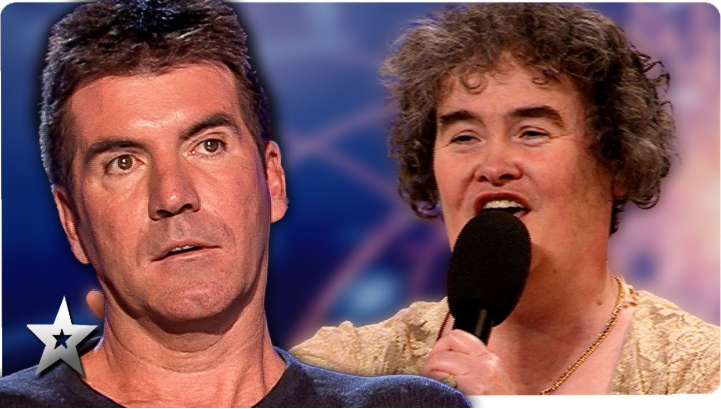
Susan Boyle’s first appearance on Britain’s Got Talent did more than introduce a powerful new singer. It captured the exact moment an entire theater realized its first impression had been completely wrong.
The Scottish performer appeared during the opening episode of the show’s 2009 season and chose “I Dreamed a Dream” from the musical Les Misérables. The linked video was uploaded on April 11, 2009, the same date identified in its title as the original broadcast, and has since accumulated more than 264 million views.
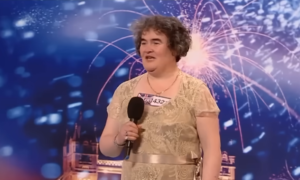
Before Boyle began singing, the atmosphere seemed uncertain. Some audience members appeared amused by her ambition to become a professional performer, while judges Simon Cowell, Amanda Holden and Piers Morgan did not yet know what kind of voice they were about to hear.
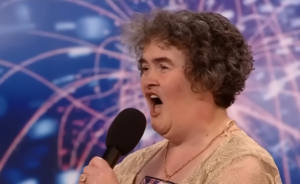
Boyle’s opening notes immediately produced a dramatic reaction. Her clear, controlled voice surprised the judges, and the audience quickly shifted from uncertainty to loud applause.
Britain’s Got Talent later described the performance as one of the most unforgettable auditions in the program’s history, highlighting how Boyle shocked the judging panel with her rendition of the famous Les Misérables song.
The performance became especially powerful because viewers could watch public opinion changing in real time. The person standing onstage had not changed, but the audience’s understanding of her had.
That transformation helped turn the audition into more than a strong vocal performance. It became a lasting lesson about assumptions, appearance, age and the danger of deciding what someone can do before giving them an opportunity.
Susan Boyle Had Pursued Music Long Before BGT
Although Britain’s Got Talent introduced Boyle to a worldwide audience, she was not completely new to performing.
Boyle comes from Blackburn in West Lothian, Scotland, and had been singing from a young age. Before appearing on BGT, she studied at the Edinburgh Acting School, participated in the Edinburgh Fringe, performed locally and appeared on the ITV program My Kind of People.
She had also stepped away from singing for a period while caring for her mother. Her decision to audition for Britain’s Got Talent eventually provided the platform that her earlier performances had not.

When she reached the television stage at age 47, Boyle was not beginning her interest in music. She was finally receiving a large enough audience to hear what she had spent years developing.
The Audition Became an Early Internet Phenomenon
Boyle’s performance arrived at a major moment in online-video history.
The audition spread internationally within days of appearing online. The Guardian reported that the performance became one of the fastest-spreading viral videos of its time, surpassing 100 million combined YouTube views within months.
By the end of 2009, YouTube named Boyle’s Britain’s Got Talent appearance its most-watched video of the year. Contemporary reports estimated that the audition had attracted more than 120 million views across its leading uploads by that point.
This level of attention was extraordinary in 2009, when social media and online video were far less developed than they are today. Boyle became internationally recognizable before many television viewers outside Britain had even watched a full episode of the show.
Her story appeared across global news coverage, and her sudden rise demonstrated how an emotionally powerful television moment could travel across borders almost instantly.
The Song Perfectly Matched the Moment
“I Dreamed a Dream” was an especially meaningful choice for Boyle’s audition.
The song carries themes of hope, disappointment and dreams that have survived difficult circumstances. As Boyle performed it, viewers were watching one of her own ambitions begin to become real.
There were no dancers, visual effects or complicated stage designs. Boyle stood in front of the judges with a microphone and relied almost entirely on her voice.
Classic FM later described her performance as a life-changing moment, noting that her rich mezzo-soprano voice immediately captured the room and that she eventually finished as the competition’s runner-up.
The simplicity of the performance made its emotional impact stronger. Nothing distracted from the contrast between what the audience initially expected and what Boyle actually delivered.
She Did Not Win Britain’s Got Talent
Boyle advanced through the competition and reached the final of Britain’s Got Talent Series 3. She ultimately finished in second place behind dance group Diversity.
However, losing the final did not stop her career.
Later in 2009, Boyle released her debut album, also titled I Dreamed a Dream. She subsequently released eight studio albums, toured internationally and became one of the most commercially successful and recognizable contestants connected with the Got Talent franchise.
She returned to talent-show television in 2019 for America’s Got Talent: The Champions, where her performance earned a Golden Buzzer and took her into the final.
Her Story Continued Beyond the Viral Moment
Boyle’s success was not limited to one famous audition.
She built a recording career, released an autobiography and took on several acting appearances. Her releases include albums such as The Gift, Someone to Watch Over Me, Standing Ovation, Home for Christmas, Hope, A Wonderful World and Ten.
Her journey also included personal challenges. Boyle suffered a stroke in April 2022 and later underwent speech therapy and vocal training as part of her recovery. She returned to Britain’s Got Talent in 2023 and again performed “I Dreamed a Dream,” publicly revealing the health struggle she had experienced.
In 2026, she continued discussing her desire to sing, perform and potentially create new music, showing that the audition was the beginning of a long career rather than a brief internet sensation.
Why People Still Watch the Audition
Susan Boyle’s audition remains meaningful because the emotional story is understandable within seconds.
A contestant walks onto the stage.
People form an opinion.
She begins singing.
The opinion changes.
The moment does not require viewers to understand complicated musical technique or know Boyle’s full background. The surprise and emotional reversal are immediately visible.
It also speaks to people who have felt ignored, underestimated or told that their opportunity has passed. Boyle’s breakthrough arrived at 47, after years of local performances and personal responsibilities that had prevented her career from developing earlier.
Her success challenged the idea that major opportunities must arrive at a particular age or follow a conventional path.
One Audition That Became Television History
Susan Boyle walked onto Britain’s Got Talent as an unknown Scottish singer with a personal ambition.
A few minutes later, she had delivered a performance that would spread around the world, become YouTube’s most-watched video of 2009 and launch an international recording career.
The audition continues to resonate because it contains something rare: the visible collapse of a first impression.
The judges changed their minds.
The audience changed its mind.
Millions of viewers discovered an artist they had never heard of before.
Boyle needed only one stage, one song and one opportunity to show them what they had almost overlooked.
